Thursday, 29 March 2012

Certificate ratings – BBFC research


- Discrimination

- Drugs

- Horror

- Imitable behaviour

- Language

- Nudity

- Sex

- Theme

- Violence

Below are the certitficates the BBFC give to films:

It is impossible to predict what might upset any particular child. But a ‘U’ film should be suitable for audiences aged four years and over. ‘U’ films should be set within a positive moral framework and should offer comforting scenes of any violence, threat or horror.

If a work is particularly suitable for a nursery to view alone, this will be indicated in the Consumer Advice.


General viewing, but some scenes may be unsuitable for young children.

Children over the age of eight would be able to watch a PG film, but any age under that would have to be accompanied by a parental figure when watching the film due to the fact that they are content may upset younger or more sensitive children.


Exactly the same criteria are used to classify works at ‘12A’ and ‘12’. These categories are awarded where the material is suitable, in general, only for those aged 12 and over. Works classified at these categories may upset children under 12 or scenes that some parents will find unsuitable for their child.

The ‘12A’ category exists only for cinema films. No one younger than 12 may see a ‘12A’ film in a cinema unless accompanied by an adult and films classified ‘12A’ are not recommended for a child below the age of 12. An adult may take a younger child if they feel that the film is suitable for that particular child. In such circumstances, full responsibilities lie to the adult for allowing a child under 12 to view the film.

The ‘12’ category exists only for video/DVD works. No one younger than 12 may rent or buy a ‘12’ rated video work. The content in films of this age may have things like horror, mild language, mild nakedness and mild violence.


No-one younger than 15 may see a ‘15’ film in a cinema. No-one younger than 15 may rent or buy a ‘15’ rated video work. The content in films of this age rating may contain language, sexual themes, volience, inappropriate behaviour and nudity.


No-one younger than 18 may see an ‘18’ film in a cinema. No-one younger than 18 may rent or buy an ‘18’ rated video work. The content in films of this age rating may include things like discrimination, drug usage, language, nudity, inappropriate behaviour, sexual themes and violence.


The ‘R18’ category is a special and legally restricted classification primarily for explicit works of consenting sex or strong fetish material involving adults. Films may only be shown to adults in specially licensed cinemas, and video works may be supplied to adults only in licensed sex shops. ‘R18’ videos may not be supplied by mail order. In terms of the content of the film, this rating may include everything that the films rating is based on.


Information From The British Board of Film Classification (BBFC)

Wednesday, 28 March 2012

Storyboard and Script


Storyboard

What a storyboard means?Having a storyboard is vitally important in determining the success and quality of your movie. A storyboard is simply a sequence of images that tell what the scenes that your movie will go through. Your movie flow will follow what the storyboard depicts.


Examples of storyboards
This is an example of a storyboard, of one of Alfred Hitchcock's films Psycho (1960) that was given to me in my media studies class.

2nd Page
1st Page


Why is a storyboard important?
Clarity during development - By having a storyboard, the production team will be clear of what is expected of them and they will have a clear overall picture of what the whole movie will look like.

 Improved movie quality - A movie will be enjoyable when the camera angles are correct. That is when the zooming fits in nicely and the characters are properly portrayed. This is integral also for animation productions. So when all this is shown on the storyboard and errors are corrected, the final movie will be more enjoyable to the audience.

Cost reduction - Without a proper storyboard, the whole scene of a movie needs to be redone when it is deemed unsatisfactory. But with a storyboard, the scenes are laid out on paper and unsatisfactory ones can be redrawn using a new storyboard even before the movie goes into production. This saves time and resources.
My Groups Storyboard Plan (for the prelim task)  

This is a storyboard a member of my group made and it isn’t the best of drawings, but this gives an indication of what the film sequence is going to involve. What this storyboard explains is of a man, who wants his money back from an individual. But little did he know that the scared individual (man) hasn't got his money. So this creates a serious problem. 


Scripts


What a film script means?
A script is a written work that is made especially for a film or television program. Screenplays can be original works or adaptations from existing pieces of writing. 

Examples of a film scripts
Below is an example of a film script, of 'The Bourne Identity'.
DARKNESS. THE SOUND OF WIND AND SPRAY.

MUSIC.  TITLES.

EXT. OCEAN -- NIGHT

The darkness is actually water.  A SEARCHLIGHT arcs across
heavy ocean swells.  Half-a-dozen flashlights -- weaker
beams -- racing along what we can see is the deck of an
aging FISHING TRAWLER.

FISHERMEN struggling with a gaff -- something in the water --

A HUMAN CORPSE.

EXT. FISHING BOAT DECK -- NIGHT

THE BODY sprawled there.  The Sailors all talking at once --
three languages going -- brave chatter to mask the presence
of death --

SAILOR #1
-- Jesus, look at him --

SAILOR #2
-- what? -- you never saw a dead
man before? --

SAILOR #3
-- look, look he was shot --
(nudging the body--)

SAILOR #1
-- don't, don't do that --

SAILOR #2
-- he's dead, you think he cares? --

SAILOR #1
-- so have some respect -- it's a --
(stopping as--)

THE BODY MOVES! -- convulsing -- coughing up sea water -- the Sailors -- freaked -- jumping back -- standing there, as --

THE MAN begins to breathe.

My Group Film Script (for the prelim task)   


A male walks into a room (in a angry mood) where a female is located.
Seun
-- Where's my  money !!! --

Sandra
-- I don't know ??? --

Seun
--If you don't have my money by 24 hours, you know what going to happen to you !!! --

Sandra
--SHOCKED reaction-- 


This is my groups own film script (for the prelim task). The reason why it is short, is because the prelim task only lasts no longer than 1-2mins. As it only needs show required media aspects, such as 'shot reverse shot'.


Why a film script is important?
A film script is important because it allows the film stars, director, etc to know what is expected of them and they will have a clear overall picture of what the whole movie will look like. But most importantly film stars are occasionally allowed to go against the script and say something that not on it. Meaning film scripts are flexibly, just a indication of the narrative.


Monday, 26 March 2012

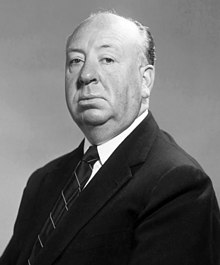
Alfred Hitchcock - One Of The Best

Sir Alfred Joseph Hitchcock, (13 August 1899 – 29 April 1980) born in Leytonstone, London, England, the second son and youngest of three children of William Hitchcock, was on of the best British film director, producer and cameo appearance actor. He led the way for many techniques in the suspense and psychological thriller genres. After a successful career in British cinema in both silent films and early talkies, Hitchcock moved to Hollywood.
His career was more than half a century long, and he fashioned for himself a distinctive and recognizable directorial style. He establised the use of a camera made to move in a way that mimics a person's gaze, forcing viewers to engage in a form of voyeurism. He framed shots to maximize anxiety, fear, or empathy, and used innovative film editing. His stories frequently feature fugitives on the run from the law alongside "icy blonde" female characters. Many of Hitchcock's films have twist endings and thrilling plots featuring depictions of violence, murder, and crime, although many of the mysteries function as decoys or "MacGuffins" meant only to serve thematic elements in the film and the extremely complex psychological examinations of the characters. Hitchcock's films also borrow many themes from psychoanalysis and feature strong sexual undertones. Through his cameo appearances in his own films, interviews, film trailers, and the television program Alfred Hitchcock Presents, he became a cultural icon.

Hitchcock directed more than fifty feature films in a career spanning six decades. Often regarded as the greatest British filmmaker, he came first in a 2007 poll of film critics in Britain's Daily Telegraph, which said: "Unquestionably the greatest filmmaker to emerge from these islands, Hitchcock did more than any director to shape modern cinema, which would be utterly different without him. His flair was for narrative, cruelly withholding crucial information (from his characters and from us) and engaging the emotions of the audience like no one else." The magazine MovieMaker has described him as the most influential filmmaker of all-time, and he is widely regarded as one of cinema's most significant artists.


Information from Wikipedia 

Thursday, 15 March 2012

History of Thriller

The History of Thriller Genre  
Thriller genre is one of the most popular genre in the film industry and remains to be popular with it’s audience. The main aim of a thriller genre is to thrill the viewer of the film, also the films tend to be rushing, gritty, exciting, it drives the narrative, has tension, has surprises, fast-paced and most of the time have a cliff hanger. The different types of thrillers are action, psychological, crime, spy, conspiracy, disaster and political thriller. The convention of a thriller genre is that crime is the main story line, there is a complex narrative structure with clues and false paths, there is a protagonist and an antagonist, enigmas are established, extraordinary events happen and the opening scene normally shows the protagonist in danger. 
The Three Apples and also One Thousand and One Nights and these are murder mystery. 
Ancient epic poems like Epic of Gilgamesh, Homer's Odyssey and the Mahabharata use similar narrative techniques and conventions as modern thrillers. In the ancient poem Odyssey, the hero Odysseus makes a bare journey home after the Trojan War, battling extraordinary hardships in order to be reunited with his wife Penelope. He sees villains such as the Cyclops, a one-eyed giant, and the Sirens, whose sweet singing lures sailors to their doom. In most cases, Odysseus uses cunning instead of brute force to overcome his adversaries. Also the genre thriller comes about with thriller stories such as
Alfred Hitchcock began his career with his first silent film The Lodger (1926), a suspenseful Jack the Ripper story, followed by his next thriller Blackmail (1929), his first sound film. However, of Hitchcock's fifteen major features made between 1925 and 1935, he only made five thrillers, the two mentioned above plus  Number Seventeen, The Man Who Knew Too Much , and The 39 steps (1935). and one of the earliest spy films was Fritz Lang’s Spies (1928). Alfred Hitchcock continued with suspense-thriller by the production of Foreign Correspondent (1940), the haunting OScar-nominated Rebecca (1940). Shadow of a Doubt (1943) was Hitchcock's personal favorite and based upon the actual case of a 1920s serial killer known as The Merry Widow Murderer.
The 1970’s and 1980’s decade saw a violent start in the thriller genre, with Frenzy (1972), Hitchcock's first British film in almost two decades, being given an R rating for its vicious and explicit scene and Steven Spielberg's low-budget early TV movie Duel (1971). One of the first films about a fan being disturbingly obsessed with their idol was Clint Eastwood's directorial debut film, Play Misty for Me (1971).
Spy and conspiracy films were popular through this decade. Don Siegel's The Black Windmill (1974), Alan Pakula's The Parallax View (1974) Sam Peckinpah's final film, the plot twisting spy film The Osterman Weekend (1983), The Fourth Protocol (1987), derived from a script by the original novelist Frederick Forsyth, featured Michael Caine and Pierce Brosnan.
The 1990’sdecade started with Rob Reiner's Misery (1990). In one horrifying scene, she 'hobbles' his ankles so that he can't escape, a battered wife who left her aggressive husband to find a better life was vengefully pursued in Sleeping with the Enemy (1991), Curtis Hanson's The Hand That Rocks the Cradle (1992). From all this it brought out great thriller films such Pulp Fiction (1994), The Dark Knight (2008), Inception (2010), Goodfellas (1990), The Silence of the Lambs (1991), The Usual Suspects (1995) and Se7en (1995).
From the history to the present, thriller dominates the film screen. The genre today is the vehicle for filmmakers, with explosive action sequences, cool new technology and twisted plotting.